

Green Accountability: COMINSUD and World Resource Institute fight against Climate Change
In May 2024 the World Resources Institute (WRI) open up for grant proposals from civil society organizations (CSOs) that are working to make climate finance and policymaking more transparent, inclusive and accountable. In Cameroon, Community Initiative for Sustainable development (COMINSUD) alongside Cercle International pour la Promotion de la Création (CIPCRE), Service d’Appui aux Initiatives Locales de Developpement (SAILD), Action for Sustainable Development (ASD) and Women for a Change had proposal that were accepted for financing by WRI to run from November 2024 – October 2025.
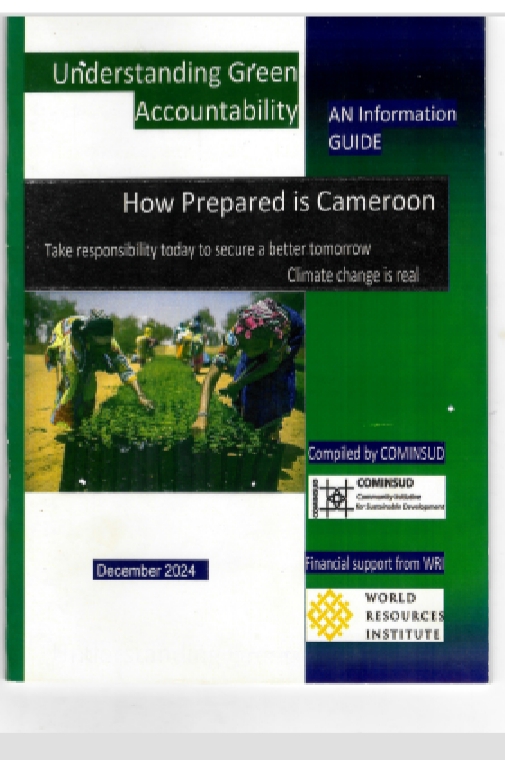
COMINSUD’s proposal focuses on weak engagement of national CSOs, Regional and Municipal Authorities, local communities and affected populations in climate governance processes as contain in policy documents such as the, Growth and Develop Strategy Paper (GDSP), National Climate Change Adaptation Plan, Nationally Determined Contribution (NDC) and sectoral strategies. This is associated with insufficient information, weak capacities and the absence of a proper framework to engage with public actors, that hinders participation and erodes contributions by CSOs and local actors in enhancing green accountability in climate governance processes. As a consequent, poverty continue to deepen amongst the masses who struggle to survive in a turbulent economic context charactered by persistent security crisis especially in ecological fragile and sensitive regions, amidst deceptive favourable economic growth indicators at country level.
As the world faces unprecedented environmental challenges, the need for a new approach that extends the principles of Social Accountability into the climate space, to empower individuals and communities to ensure that climate finance is used effectively, equitably, and transparently becomes more urgent.
Why This Guide?
This guide has been developed to provide clear, concise, and accessible information on climate change financing, green accountability, and climate governance, helping stakeholders understand their roles in addressing climate challenges. It serves as a practical tool for empowering civil society organizations (CSOs), local government actors, and community representatives to engage effectively in climate governance processes and advocate for transparent, sustainable financing mechanisms.
The guide aims to:
- Enhance awareness of climate change financing sources and mechanisms.
- Strengthen capacity for monitoring and promoting green accountability.
- Support policy engagement by aligning local actions with national and international climate frameworks.
- Provide practical steps for communities to participate in climate governance initiatives.
 Community Initiative for Sustainable Development