

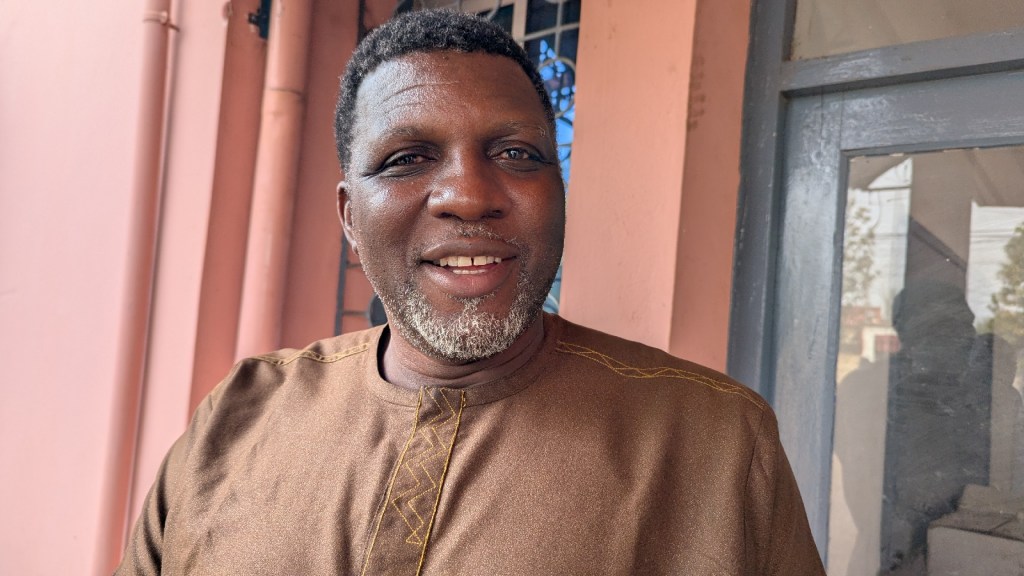
This follows a meeting of stakeholders in the water, sanitation and hygiene (WASH) sector in Cameroon’s North West Region. A key outcome of the General Assembly was the adoption of the platform’s Articles of Association and the election of a transitional executive team to pilot activities until a full elective general assembly is held. Fon Nsoh, Coordinator of Community Initiative for Sustainable Development (COMINSUD), was elected Chairperson.
He will be supported by Ambo Gaby of Finders Group Initiative (FGI) as Deputy Chairperson, and Patience Ndifor of the Society for Initiative for Rural Development and Environment Protection (SIRDEP) as Finance Officer. The leadership team is part of an eight-member executive committee tasked with steering the platform’s initial phase.
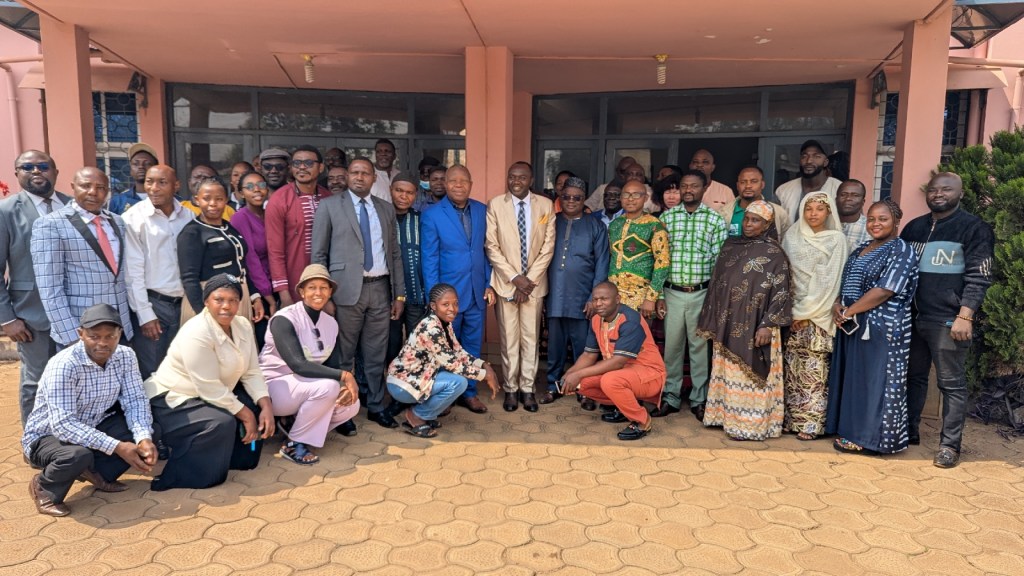
The two-day Constituent General Assembly which held from Wednesday, January 28 to Thursday, January 29, 2026, in the North West Regional capital of Bamenda, took decisive steps toward improving the sustainability of water supply systems in the Region.
The assembly was organized under the auspices of the Ministry of Water Resources and Energy (MINEE), through its Regional Delegation for the North West, in close collaboration with the Norwegian Refugee Council (NRC).
Opening the assembly, Akia Fonketi Emmanuel, Regional Delegate of Water Resources and Energy for the North West, underscored the strategic importance of WASH beyond infrastructure. “WASH is not merely a sector, it is a foundation for public health, human dignity, social stability and sustainable development,” he said.
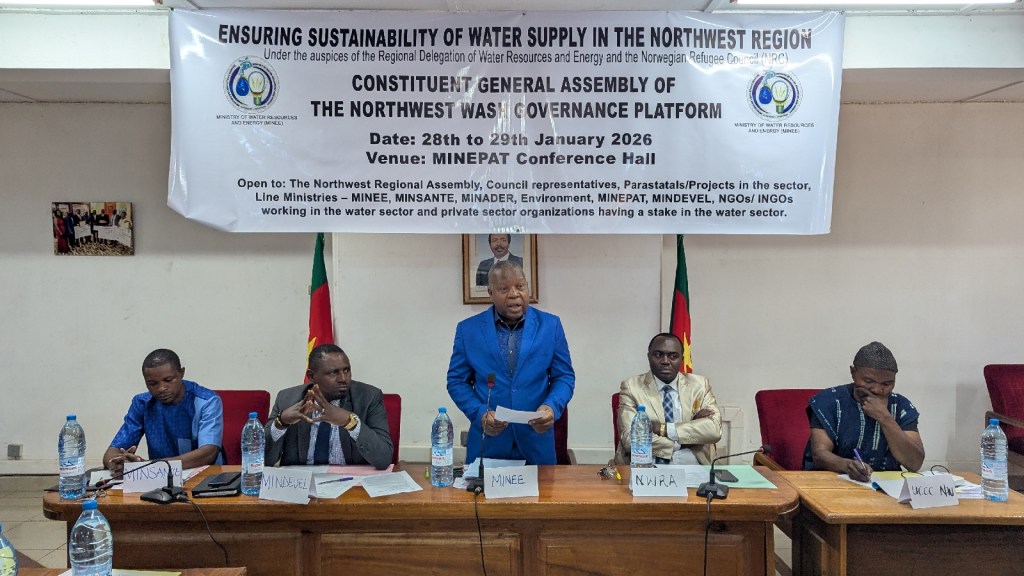
He described the gathering as a critical milestone for strengthening coordination among stakeholders, harmonizing interventions, promoting accountability, and ensuring inclusive and sustainable WASH services particularly for women, children, persons with disabilities and crisis-affected communities.
Against a backdrop of rapid urbanization, climate variability and prolonged humanitarian challenges in the region, Akia Fonketi noted that the establishment of a regional WASH governance platform was both timely and strategic. He called for collective ownership, stressing that neither government nor development partners can succeed in isolation.
One of the strongest messages of the conference was the urgent need to move beyond the construction of water infrastructure to ensure long-term functionality.
In a keynote presentation, the WASH/Shelter Project Manager for the NRC Bamenda, Afunwi Denis, highlighted alarming statistics linking unsafe water to public health outcomes. He cited national data showing tens of thousands of diarrheal cases and hundreds of thousands of typhoid cases annually, many directly linked to contaminated water. “Constructing a borehole is the easiest part of WASH service delivery,” Afunwi said. “The most difficult part is ensuring that it continues to function months and years after commissioning.”
Drawing on NRC’s experience in the North West and South West regions since 2018, where the organization has reached over 200,000 people with WASH services, he explained that many water systems failed within months due to weak management, a lack of capacity, and poor coordination. This reality, he said, inspired the multi-year consultative process that led to the birth of the governance platform.
A Systems Approach to Water Governance
Technical insights were provided by Mr. Tayong Andrew Mbakwa, Director of BOKA Engineering Company and long-time consultant to NRC. He presented the conceptual framework underpinning the platform, defining sustainability through four lenses: technical, financial, institutional and environmental.
An evaluation by the WASH Cluster in 2025 revealed that 51 percent of water points constructed in recent years did not meet sustainability expectations. The platform, he explained, is designed as a support and coordination structure not a replacement for existing actors to help standardize practices, strengthen capacity and guide stakeholders toward evidence-based solutions. “The idea is to help actors in the field do things the right way so that investments deliver lasting results,” Tayong said.
Call for Synergy and Accountability
Wrapping up the conference on behalf of the Regional Delegate, Afah Benedict Abengang, Regional Chief of Water and Sanitation for the North West, praised participants for what he described as a “solid first step” in a long journey. “This was a preparatory meeting,” he said. “If the first step is not solid, you cannot finish the race.”
He urged WASH actors to work in synergy and avoid the common scenario of newly constructed water projects breaking down within a year. Emphasizing collective responsibility, he reassured participants who were not elected that the platform belongs to all stakeholders. “This platform is coming to stay,” he declared. “Some of us will leave the stage of life, but the next generation will continue from where we stop.”
Looking Ahead
In post-conference interviews, NRC and platform leaders expressed optimism about the road ahead. Immediate priorities include finalizing governance documents, registering the platform legally, preparing for World Water Day 2026, and organizing a regional conference on financing water system sustainability.
Beyond these short-term actions, the North West WASH Governance Platform aims to become a reference model for Cameroon strengthening coordination, improving accountability, and ensuring that water supply and sanitation systems deliver reliable services for generations to come.
 Community Initiative for Sustainable Development